

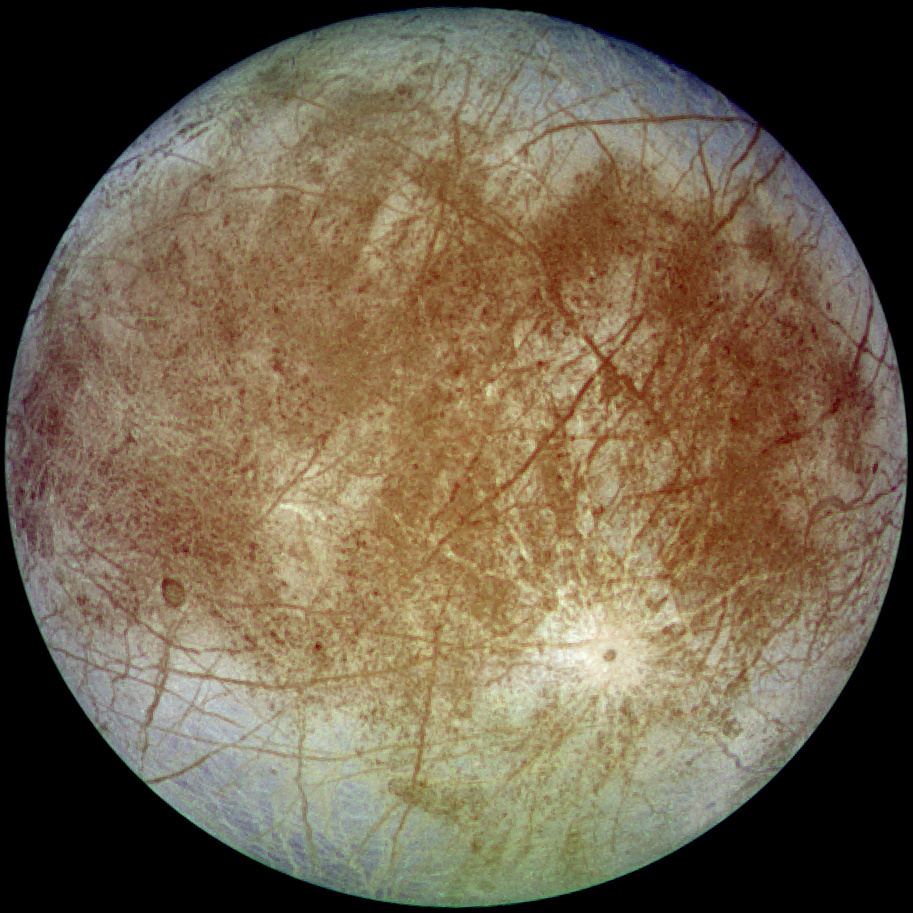
Europa, the ice-covered moon of Jupiter, remains one of the most promising places to search for life beyond Earth, and new observations are bringing its hidden ocean into clearer focus. Beneath a fractured shell of ice, scientists believe a salty global ocean is kept liquid by tidal heating as Jupiter’s gravity flexes the moon on every orbit. Recent studies of surface cracks, ridges and chaotic terrain suggest that material from below sometimes reaches the surface, giving spacecraft a chance to sample ocean chemistry without drilling through kilometres of ice. Instruments now in flight and in development are designed to measure the ice thickness, map magnetic signals from the ocean and analyse particles ejected into space. Together, those measurements could reveal the ocean’s depth, salinity and energy sources, the three factors that determine whether it could support life. Researchers stress that finding habitable conditions is not the same as finding life, but Europa offers a rare test case where the ingredients may all be present.
What the Evidence Shows
The challenge ahead is turning remote measurements into a coherent picture of a world no probe has yet landed on. Specialists following Europa subsurface ocean exploration say that surface features must be read carefully, because ice can deform, refreeze and bury evidence over time. Modelling teams are therefore combining observations from different instruments to distinguish fresh cracks from ancient terrain and to estimate how quickly ocean material moves upward. Engineers are also weighing the risks of radiation near Jupiter, which can damage electronics and limits how long a spacecraft can operate close to Europa. Despite those hurdles, scientists argue that the moon rewards patience, since even a negative result would sharpen the search elsewhere. If Europa’s ocean proves too hostile or too isolated, that lesson will guide missions to other icy moons and reshape expectations for life in deep, dark oceans. Reporting and analysis from sources such as National Science Foundation track the same developments, and specialists following Europa subsurface ocean exploration say the direction is now consistent across independent lines of evidence.
The Wider Context
The wider context is a research landscape in which replication and open data now decide reputations. Findings connected to Europa subsurface ocean exploration are being checked by independent groups with shared datasets, and the teams involved publish their methods in full so rivals can test every step. That discipline is slower than a headline cycle, but it is why results in this area increasingly survive first contact with scrutiny.
What Happens Next
What happens next in the story of Europa subsurface ocean exploration will be decided by follow-up work already under way: larger samples, longer observation and instruments that have not yet come online. The researchers involved are unusually united on one point, that the current results justify the next investment of time and money. Readers will not have to wait long for the first tests of that claim. You can follow related developments in our coverage of science.
There is a practical lesson in all of this for readers deciding what to do today. Start with the verified facts, be wary of anyone promising certainty, and prefer reversible steps while the evidence is still developing. Circumstances differ by country, income and personal situation, so general guidance should always be weighed against your own context before you act on it in any significant or lasting way.
